Truck Loans Australia Truck Loan Repayment Calculator
Use our Truck Loan Calculator to estimate repayments, compare finance options, and plan your purchase with ease. Fast, simple, and tailored for Australian businesses and drivers.
Calculator results are estimates based on inputs and assumptions and are provided for general information only. They are not quotes, offers, approvals, eligibility decisions or personalised recommendations, and do not indicate that a lender will provide credit. Actual repayments and costs may differ.
Truck Loan Details:
Important!
Truck Loan Interest Rates differ from lender to lender and will depend on your individual circumstances (credit history, employment status, age, etc.).
Truck Loan Amortisation Calculator
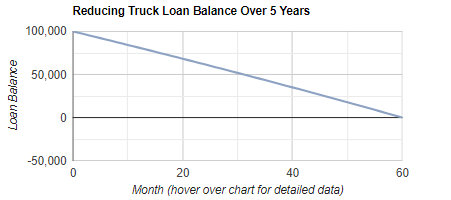
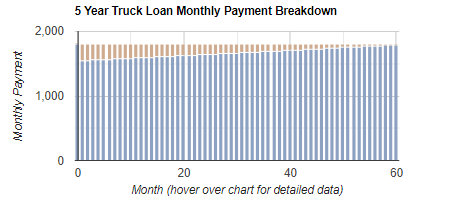
The following amortisation graphs detail month-by-month data on the progress of the proposed loan. The first chart below examines the reducing loan balance over the course of the finance contract term. The second graph illustrates the portion of each monthly repayment allocated to payment of interest vs principal reduction.
How to use our Truck Loan Repayment Calculator
Our Truck Loan Repayment Calculator helps Australian drivers and businesses estimate loan repayments before you commit. It is designed to support budgeting, cash flow planning, and comparing truck finance scenarios by showing how changes to price, deposit, term, and interest rate can affect your repayments and total interest cost.
How to complete the calculator for the most accurate estimate
1. Purchase Price
Enter the total purchase price of the truck you plan to finance. Consider including eligible on-road and purchase-related costs that may be financed (for example registration, insurance, or other costs where applicable). Use whole numbers only, without commas or decimals.
2. Deposit or Trade-in Value
If you are paying an upfront deposit or using a trade-in, enter that amount here. This reduces the amount you need to borrow and can lower repayments and total interest. Use whole numbers only.
3. Term of Loan (Years)
Select the loan term in years. In general, a longer term can reduce the periodic repayment but may increase the total interest paid over the life of the loan. Choose a term that suits your expected truck usage and business cash flow.
4. Interest Rate (Percent per annum)
Select an interest rate to model your scenario. Rates vary by lender and borrower circumstances, so it can be helpful to test a conservative rate as well as an optimistic one.
5. Calculate
Select calculate to generate your repayment estimate and repayment breakdown visuals.
How to interpret your results
1. Repayment estimate
Use this as a guide to affordability and budgeting. If the repayment is tight, test a higher deposit, shorter term, or different interest rate.
2. Amortisation and graphs
Review how the loan balance reduces over time, and how each repayment typically shifts from mostly interest early on to more principal later. This can help with planning for refinancing, early payout, or upgrade timing.
ASIC compliance note: This calculator provides information only and is not financial or credit advice. Results are estimates and may not include all fees, charges, taxes, residuals or balloon payments. Consider your objectives and financial situation, and seek independent advice or a lender quote before proceeding.
Small businesses that require regular transportation of goods may find it essential to purchase a truck. However, this acquisition can become a significant investment that requires careful consideration before making a decision. The two options available are buying or leasing a truck. In this article, we will explore the pros and cons of each option to help you make an informed choice. - read more
Securing finance for any significant purchase can be a challenge, especially when it comes to acquiring a truck for business purposes. Coupled with a less-than-perfect credit score, this task can seem daunting for many Australians. The ripple effects of financial constraints can impede business operations, affecting the lifeline of commercial ventures that rely on transportation. - read more
For many Australian businesses, purchasing a commercial vehicle is a significant investment that often requires financial assistance. Understanding the intricacies of truck financing is crucial, as the right loan can affect your company's bottom line and operational efficiency. With a plethora of lenders offering myriad loan products, choosing the most advantageous deal can be daunting. - read more
Welcome to the road less traveled, where the rubber meets financial prudence. Truck driving in Australia is not just about long miles but also about ensuring financial stability amidst life's crossroads. As a truck driver, taking the wheel of your financial future is crucial, and that's what we'll navigate in this article. - read more
Trucks play a pivotal role in the Australian logistics and transport industry, serving as the lifeblood that keeps commerce flowing. The dependable rumble of engines crisscrossing the nation's highways is more than just a symbol of industry; it's a critical component of productivity and economic stability. Without these workhorses facilitating the timely movement of goods, the Australian market would face significant challenges meeting the demands of both businesses and consumers alike. - read more
The Reserve Bank of Australia’s 29 September 2026 decision to lift the cash rate by 25 basis points to 4.60 per cent has put borrowing costs back at the centre of household and business planning. While the cash rate is not the only factor behind loan pricing, it influences funding costs and can flow through to variable rates, new fixed-rate offers and lender appetite for risk. - read more
The Reserve Bank of Australia's decision on 29 September 2026 to lift the cash rate target by 25 basis points to 4.60 per cent has put loan affordability back in focus for households and small business operators already managing higher everyday costs. While the cash rate does not mechanically set every personal loan or short-term credit price, it influences funding costs, lender risk settings and the way borrowers think about repayment buffers. - read more
The Reserve Bank of Australia’s October 2026 Financial Stability Review gives borrowers a mixed but useful message: the financial system remains broadly resilient, yet cost pressures, hardship requests and sector-specific business stress are still important warning signs for households and SMEs planning their next finance decision. - read more
The Reserve Bank’s latest decision to keep the cash rate steady gives Australian boat buyers a useful moment to pause, but it should not be mistaken for a guarantee that borrowing costs will stay simple or uniform. For households looking at a first trailer boat, a fishing upgrade, a personal watercraft or a larger family cruiser, the lending market remains highly dependent on borrower profile, boat type, deposit size, loan structure and lender appetite. - read more
Financial hardship support is back in the spotlight across Australia’s lending market, with regulators and consumer advocates paying closer attention to how banks and non-bank lenders respond when borrowers ask for help. For households and small business owners already dealing with higher living costs, tax obligations, insurance premiums and uneven cash flow, this is more than a compliance story. It is a practical reminder that loan stress should be addressed before it becomes a missed-payment pattern. - read more